Examination no. 05 / local conditions
Maple Seed, Oak Catkins and the Spring Load
Gutter guard marketing is written about autumn. In these neighbourhoods autumn is the easy half of the year.
Why autumn is the easy case
Leaf fall is the image the whole category sells against, and it is the load a guard handles best. Autumn leaves are large, they mostly arrive dry, and a dry leaf on a screen behaves well: it sits on the surface, it does not conform to the openings, and the next dry windy day takes a good proportion of it off the roof entirely.
Even where leaves do stay put, they stay put as a layer. A layer can be brushed off. It does not become part of the guard.
Why spring is the hard case here
From late March into May, the mature tree cover in the older parts of this metro unloads three things at once, and all three are the wrong size and the wrong shape for a screen.
What you will be told
The mesh is fine enough that nothing gets through, so you are covered.What happens on the roof
Getting through is not the failure being sold against here. Staying on is.
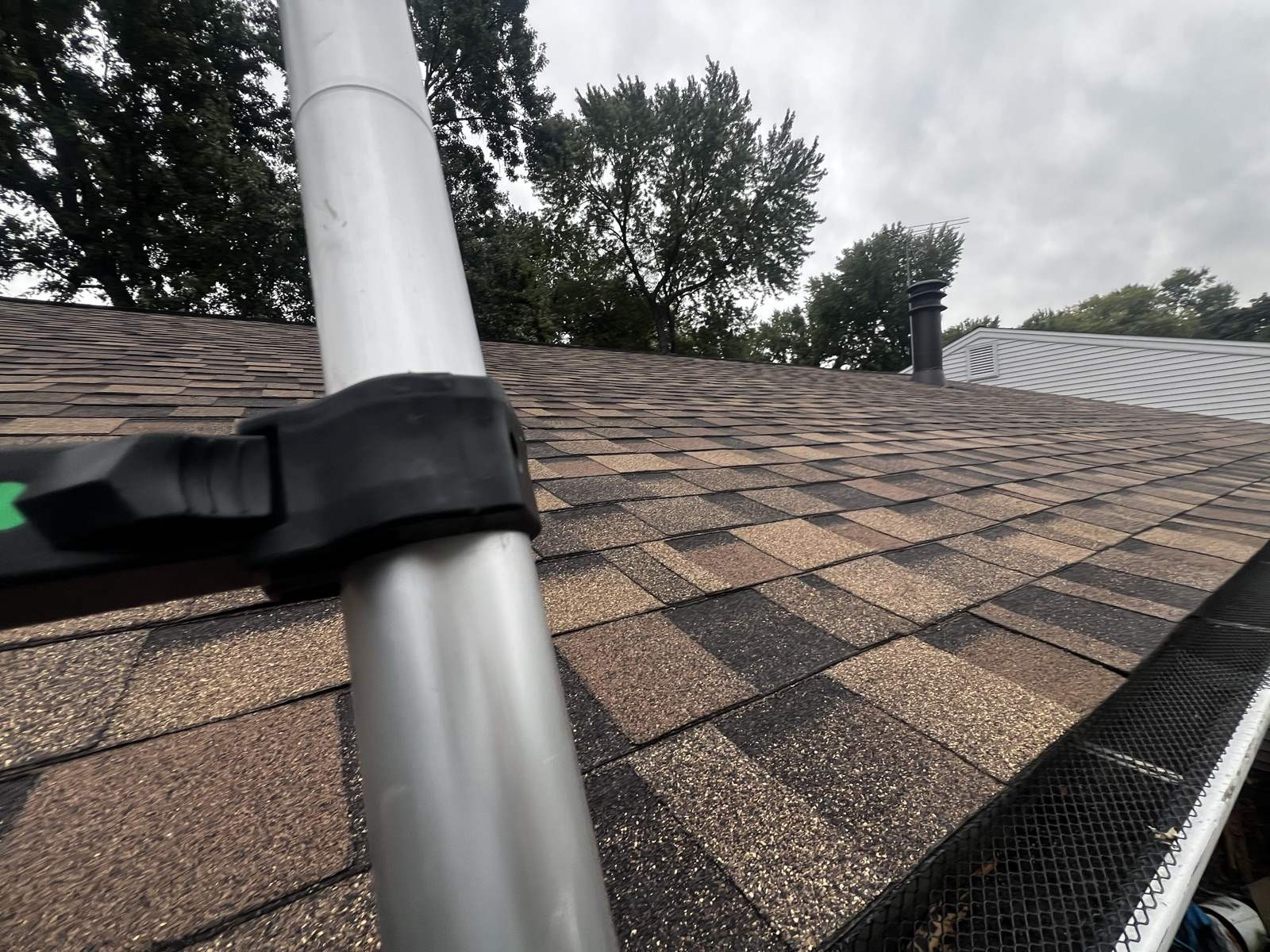
Spring debris in St. Louis does not need to get into the gutter to stop it working. It needs only to stay on top of the screen, in a wet mat, for the three weeks in which the heaviest rain of the year arrives. Water then runs down the outside of a perfectly clean gutter.
Fine is good against needles and seed passing through. Fine is also what lets a catkin mat bridge and hold. There is no aperture that solves both, which is why any honest guard conversation ends in a maintenance interval rather than a promise.
The two weeks that actually matter
If you own guards in this metro, the single most valuable habit is to look at them in the first week of May, from the ground, with the sun behind you, ideally while it is raining.
- Water coming off the front edge in a steady sheet while the gutter behind it is not running means the screen is bridged, not blocked. That is a brushing job, not a product failure.
- A dark continuous line along the top of the guard where there used to be metal or mesh colour is a mat that has been there long enough to hold moisture.
- Seedlings. Maple germinates readily in anything damp. A row of small green shoots along a gutter line is a reliable indicator that the surface has been permanently wet for weeks.
- Nothing visible at all is not proof of anything on a fine mesh, because the material that blinds a micro-mesh is too small to see from the ground. That check is done with a hand on the mesh, on a ladder, by somebody who is comfortable up there.
What this means for choosing
Under heavy maple and oak, which describes a large share of the older housing here, the realistic choice is between a fine screen that will need brushing in spring and a coarser one that will let fine material into a trough that will need rinsing. Both are maintenance. Anyone offering a third option where neither happens is describing a house with no trees over it.
The seasonal counterpart to this page is what a Missouri winter does to the fixing, and the practical version is what living with guards looks like.
The spring load
If it went wrong in April, that is the useful detail
A guard that copes all winter and overflows in the first warm week is telling you something specific about its aperture, and it is worth saying which month it happened in.
Keys Roofing works on gutters year round in greater St. Louis and can tell you what is on the mesh before deciding what to do about it.
Straight to the Keys office. Roofing, gutters and downspouts across greater St. Louis. No siding, no windows, no commercial work.