One product, taken apart / Greater St. Louis
Gutter Guards That Survive a St. Louis Spring
A gutter guard is the most aggressively sold thing that can happen to a house without a roof being involved. This desk is written by the people who fit them, and it begins by contradicting the sentence the whole category is built on.
Keys Roofing does roofing, gutters and downspouts. Call (314) 220-2333.
The claim, and the catch
Every page on this desk is built as a pair
On the left, the thing a homeowner in this market is told at the kitchen table. On the right, what the same product does on a real eave in April. We are not arguing that guards are bad. We are arguing that the sales copy is describing a different product than the one that gets screwed to your gutter.
What you will be told
Fit these and you will never clean your gutters again.What happens on the roof
No guard sold in this market makes a gutter maintenance free. Not the plastic one from the hardware store, not the stainless one with the lifetime paperwork. A guard is a filter, and every filter that has ever existed has a service interval, including the good ones.
What a well chosen guard actually buys is a change in the job. Twice a year on a ladder pulling out black sodden compost by hand and hoping the outlet underneath it is clear becomes an occasional look and a brush across a surface. That is a genuine, worthwhile, money-well-spent improvement.
It is just not the same sentence as never, and the gap between those two sentences is where this entire desk lives.
The bench / five families
What is actually for sale, and how each one fails
Every guard on the market in St. Louis belongs to one of five families. They are not better and worse versions of one product. They stop different things, they pass different things, and each one has a characteristic way of going wrong that is worth recognising before rather than after.
Fine stainless micro-mesh
A woven stainless screen stretched on a rigid frame, with apertures fine enough to stop grit as well as leaf.
- Stops
- Leaves, needles, seed, catkins, most airborne grit.
- Passes
- Water, at a rate set entirely by how clean the weave is.
- Fails by
- Blinding. Shingle granules and pollen settle into the weave and the screen quietly becomes a lid.
- Suits
- Heavy oak and maple cover, on a roof with life left in it.
Perforated and punched metal
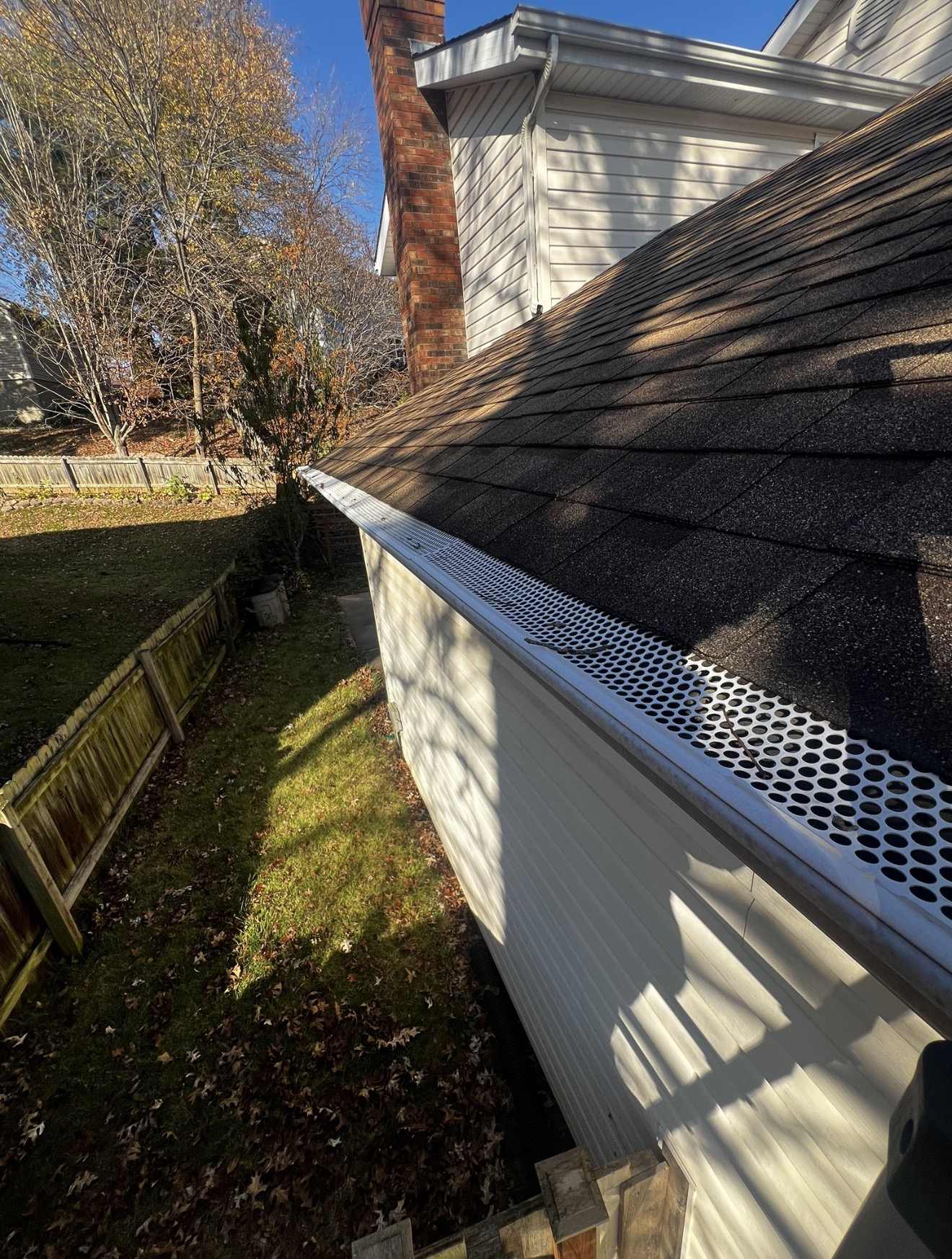
Aluminium or steel sheet with round holes punched through it, folded to sit over the trough. Plate 1 above is one.
- Stops
- Whole leaves, twigs, anything that cannot turn sideways.
- Passes
- Water freely, and anything smaller than a hole.
- Fails by
- Lifting at the lip, and by silting up one hole at a time until the open area is a fraction of what it was.
- Suits
- A straightforward eave where the aim is simply to stop the trough packing solid.
Drop-in plastic and wire screen
The cheap end. A curved screen that rests in the trough or tucks under the first shingle course, sold by the length.
- Stops
- Large leaves, tennis balls, squirrels.
- Passes
- Everything small, straight through into the gutter.
- Fails by
- Popping out. A load of wet leaves levers it, and a winter of freezing and thawing finishes the job.
- Suits
- A low, easily reached run where budget is genuinely the constraint.
Foam wedge inserts
A block of open cell foam pushed down into the trough so that the trough is no longer open. No fixings, no fabrication.
- Stops
- Leaves, from reaching the bottom of the gutter.
- Passes
- Water through the foam, for as long as the foam is clean.
- Fails by
- Filling with silt, then holding moisture, then growing things. Removing a saturated insert is worse than the job it replaced.
- Suits
- Very little, on a St. Louis house with real tree cover.
Brush inserts
A long cylindrical bristle brush laid in the trough. Debris is meant to sit up on the bristles while water runs beneath.
- Stops
- Big leaves from reaching the outlet directly.
- Passes
- Water underneath, and every small thing into the bristles.
- Fails by
- Catching. Maple seed and pine needles thread into the bristles and stay there, which turns the brush itself into the clog.
- Suits
- Broadleaf cover with no needles and no seed, which is rare here.
Reverse curve and surface tension
A solid hood that curls back over the mouth of the gutter. Water is meant to cling around the nose and turn in. Debris is meant to carry on and fall.
- Stops
- Almost everything, because the opening is a slot rather than a face.
- Passes
- Water, up to a rate, and then no more.
- Fails by
- Overshooting. Heavy rain off a steep plane arrives faster than the curve can turn it and goes over the front.
- Suits
- Moderate pitch, moderate rain, and an owner who has looked at one from the ground first.
The thing nobody quotes on
A guard is only ever as good as the trough it is bolted to
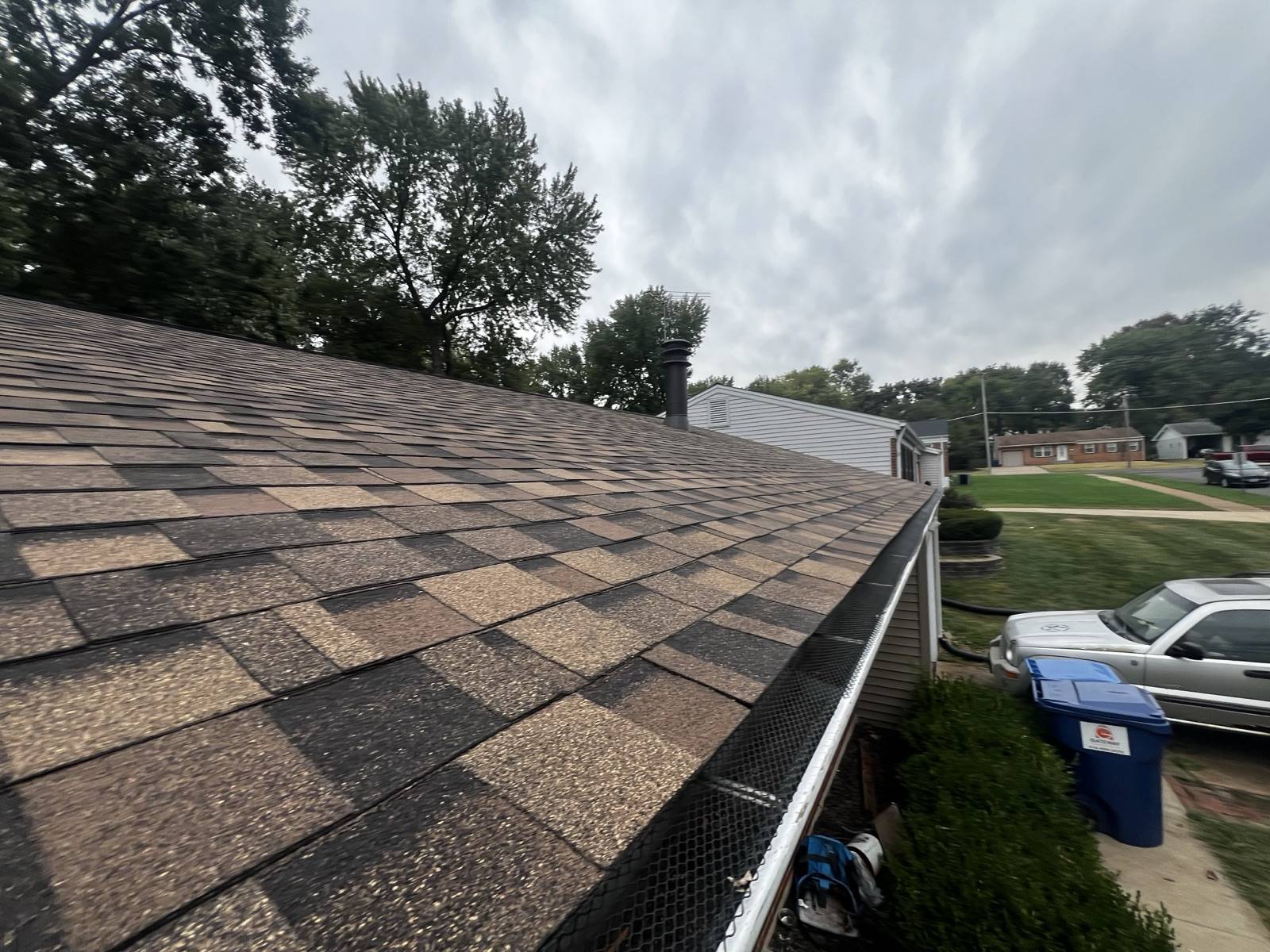
This is the part of the conversation that gets skipped, and it is the part that decides the outcome. A gutter guard adds no capacity. It adds no fall. It does not straighten a run that has pulled away from the fascia, and it cannot make a two inch by three inch outlet behave like a three by four.
Fit a guard to a gutter that was already undersized, already sagging in the middle, or already pitched the wrong way, and what you have bought is a lid. The water still overshoots in a downpour. The standing water in the low spot is still standing. The difference is that now there is a screen across the top of it and you cannot see any of it from the ground, so the first evidence you get is a stained fascia board or a wet spot inside a soffit.
Any competent assessment starts under the guard, not with the guard. If nobody looking at your house has said a word about the gutter itself, they are quoting a product, not solving a problem.
Local conditions
St. Louis has two debris seasons and they are not the same problem
Guard marketing is written nationally and it is written about autumn leaves. Autumn is the easy case. Leaves are large, they arrive dry, they sit on top of a screen and most of them blow off it eventually.
Spring is the season that decides it
From late March into May the older neighbourhoods here unload maple samaras, oak catkins and an extraordinary volume of pollen, all of it fine, stringy and arriving wet. Catkins in particular are the exact shape to lie across an opening rather than fall through it or blow off it, and a mat of them holds water against the mesh instead of shedding it.
That is why the headline on this page says spring. A guard that copes with November and blinds over in April has failed at the harder half of the year, and April is also when the heaviest rain arrives.
Winter is the season that breaks the fixing
A Missouri winter is not a deep freeze, it is a repeating freeze and thaw. Water sits in a trough, freezes, expands, thaws, refills, freezes again. Anything resting on the lip of a gutter rather than fastened to it gets levered a little further each cycle, and a guard that was firmly in place in October can be standing off the lip by the following spring.
The examinations
Ten pages, and every one of them says something bad for selling guards
No reading order is required. Each page is written to be finished and then acted on, and each one carries at least one claim set against what actually happens.
Micro-mesh and perforated metal
The two screen families, the aperture argument, and the specific thing that turns a good stainless screen into a lid: grit off the roof above it.
Screens, foam and brush
The cheap end of the category, why plastic pops out under wet leaf weight and ice, and what actually happens inside a foam insert after two St. Louis summers.
Reverse curve and surface tension
How the physics is supposed to work, why a steep plane and a cloudburst defeat it, and the reason these are the guards you can pick out from the pavement.
What is under the guard
Capacity, fall, hangers and the outlet. The four things that have to be right before a guard is worth fitting, and what a guard hides when they are not.
Maple seed, oak catkins and the spring load
Why the spring debris in these neighbourhoods is harder on a screen than autumn leaf, and what to look at in the first week of May.
Ice load and the guard that lifts
Freeze and thaw, the weight of a full trough, and why fastening is the single specification that separates a guard that lasts from one that does not.
Granules and the age of your roof
An asphalt roof sheds mineral grit for its whole life, heaviest at both ends. Why that puts guards and roof replacement in the same conversation.
When a guard is worth the money
Access, tree cover and storey height, set against the plain case where a guard is a poor purchase and we will say so.
Reading a gutter guard sales pitch
The moves the category uses, the words that should slow you down, and the eight questions that get you a real answer.
Living with guards afterwards
What maintenance actually looks like once they are on, what you still have to look at, and how to tell a blinded screen from a clear one from the ground.
The people who fit them
Keys Roofing fits guards, and turns guard work down
Keys does three things: roofing, gutters and downspouts. No siding, no windows, no commercial work. Shingle work is Atlas and Malarkey. That narrow menu is the reason this desk can afford to be blunt about a product Keys sells.
- Assessment before product. The trough, the fall, the hangers and the outlet get looked at before any guard is discussed, because a guard cannot fix any of them.
- Guards fitted where they earn it. Heavy tree cover, awkward or genuinely unsafe access, a two storey run nobody should be on a ladder for.
- Roof age asked first. If the roof above the gutter is close to needing replacement, the honest sequence is roof, then gutter, then guard.
- A plain no when it is a no. Single storey, no trees, easy access: that house does not need a guard system and we will say so on the phone.
If the guard conversation turns into a roof conversation, or the other way round, it is the same people either way. Call (314) 220-2333.
Before you sign anything
Tell us what your gutters are actually doing
The useful message is not that you want guards. It is that the back corner overflows in a hard rain, or that you have three oaks over the house and you are tired of the ladder, or that a salesman was at the door on Tuesday and you want a second opinion before Friday.
Keys Roofing fits gutter guards. Keys will also tell you, on the phone, without coming out, when your house is not a guard candidate this year and why. That conversation costs a sale and saves you a purchase.
Straight to the Keys office. Roofing, gutters and downspouts across greater St. Louis. No siding, no windows, no commercial work.