Examination no. 01 / the screen family
Micro-Mesh and Perforated Metal Guards
These two are the serious end of the category and they fail in opposite directions. One is defeated by things too small for it. The other is defeated by the way it is held on.
What the two products actually are
A micro-mesh guard is a woven stainless screen tensioned on a rigid frame, usually aluminium, with a weave fine enough that you cannot push a pencil lead through it. The frame carries the load. The mesh only has to keep material out of the trough while letting water through.
A perforated guard is a folded sheet of aluminium or steel with round holes punched in a regular grid. There is no weave and no separate frame: the sheet is the structure. Plate 1 on the front page of this desk is a punched aluminium guard, photographed on an ordinary back elevation in November.
The difference that matters is open area. A punched sheet has a lot of open area concentrated in a few dozen holes per foot. A fine mesh has less open area spread across thousands of tiny openings. That single fact drives everything below.
The aperture argument, plainly
A screen only has to be finer than the smallest thing you need it to stop. Fine that up and it stops more. Fine it up further and it starts stopping things you did not intend to stop, and then it starts stopping water.
Micro-mesh is fine enough to stop pine needles and maple seed, which is a real advantage in this market. It is also fine enough to stop mineral granules, pollen and roof dust, which is the problem. Those things do not sit on top of a weave the way a leaf does. They settle into it, and once the weave is loaded, the screen has stopped being a screen and started being a very expensive lid.
A punched sheet has the opposite behaviour. Grit passes straight through a quarter inch hole without noticing it is there. Nothing blinds. What happens instead is slower and easier to miss: individual holes take a leaf fragment or a lump of silt, and the open area comes down one hole at a time over several seasons until a section of run cannot take a downpour any more.
What you will be told
Stainless will not rust and the mesh is warrantied for the life of the house.What happens on the roof
Both halves can be true and still be beside the point. Stainless mesh really does not corrode, and the paperwork really can be generous. Neither of those things is what fails.
What fails is throughput. A screen that is chemically perfect and optically clean from the ground can still be passing a fraction of the water it passed when it went on, because the material blocking it is finer than the eye can resolve at thirty feet.
Ask what the remedy is when a mesh blinds, who performs it, how often, and whether that visit is chargeable. That is the answer that tells you what you have bought.
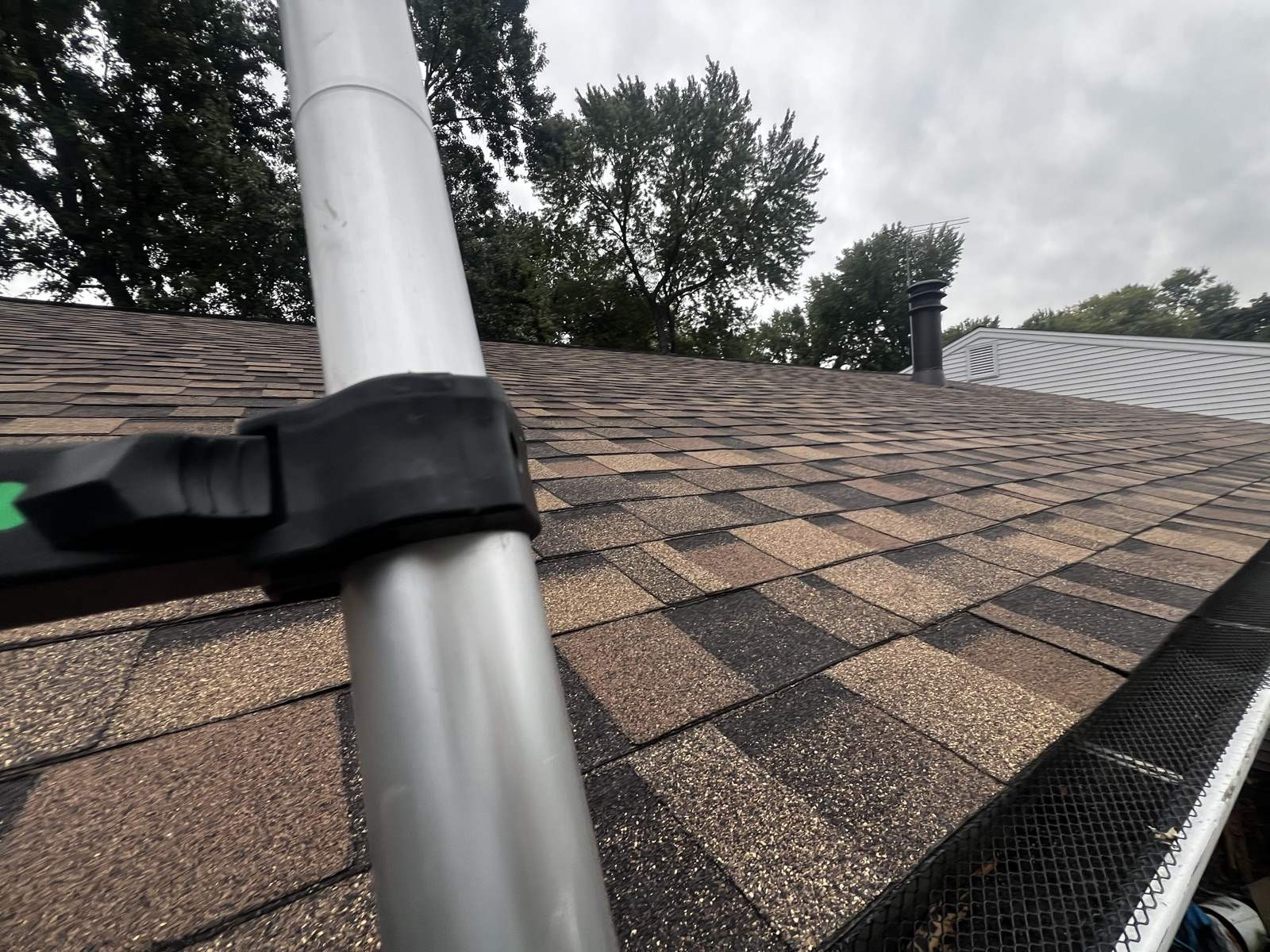
Fixing is the specification nobody reads
How a screen guard is attached decides how long it survives, and there are only three real options.
The question to ask about tucking
If a guard is going under your shingles, ask exactly how far, and ask what happens at the seal strip. A back edge pushed several inches up under the course above can hold that course open, and a shingle that is not sealed down is a shingle the next storm can lift. A gutter product should not become a roof problem, and this is the one installation fault that turns it into one.
Where each one belongs
Micro-mesh earns its place where the debris is small and constant: pines, mature maples that drop seed in volume, oaks that shed catkins in spring. It earns it least on a roof that is close to the end of its service life, because that roof is producing the exact material that blinds it. That is not a marginal effect. It is the main reason a mesh guard disappoints, and it is covered properly on the roof age page.
Punched metal earns its place where the aim is simply to stop the trough packing solid with leaf and twig, and where somebody is realistic about revisiting it. It is more forgiving of a dusty roof and less forgiving of neglect, which for many houses is the better trade.
Neither of them adds capacity to an undersized gutter, and neither of them corrects fall. Before you choose between them, read what has to be right underneath.
Screen guards
Ask before the mesh goes on, not after
The two questions that decide whether a screen guard works on your house are how old the roof above it is and how the guard is going to be fastened. Both are answerable before anybody quotes you.
Keys Roofing will look at the gutter and the roof together, because on a screen guard they are one problem.
Straight to the Keys office. Roofing, gutters and downspouts across greater St. Louis. No siding, no windows, no commercial work.