Examination no. 10 / afterwards
Living With Gutter Guards, Honestly
The guards are on. Here is what actually changed, what did not, and the small number of things worth looking at so the next problem is a small one.
What genuinely changes
The job changes character completely, and that is the point of the purchase. Before a guard, gutter maintenance means getting a ladder to the trough, reaching in and lifting out a compacted mass of decomposed leaf, silt and grit, bagging it, and then checking that the outlet underneath is not plugged with what is left. It is slow, it is filthy, and it has to be done from directly beside the work.
After a guard, in the ordinary case, it means looking at a surface and moving a layer of material off it. That can often be done from further away with a pole and a soft brush, and on a single storey run it can sometimes be done from the ground. It takes a fraction of the time and it does not involve handling anything unpleasant.
That is a real and substantial improvement. It is worth saying clearly, because a desk that only lists the drawbacks would be as one sided as the brochure.
What does not change
- The outlet still needs checking. Every blockage that ever occurs occurs where the trough narrows into the downspout. Guards reduce what reaches it, they do not eliminate it, and grit passes through every guard type sooner or later.
- The downspout still needs checking. A guard does nothing about what is already in the pipe, and nothing at all about where the water goes once it leaves the bottom of it.
- Fall and hangers still age. The trough continues to carry weight, the fixings continue to work in the wind, and the fascia behind them continues to be a piece of wood outdoors.
- Spring still happens. Whatever the guard is, April will put a load on it that November did not. See the spring load.
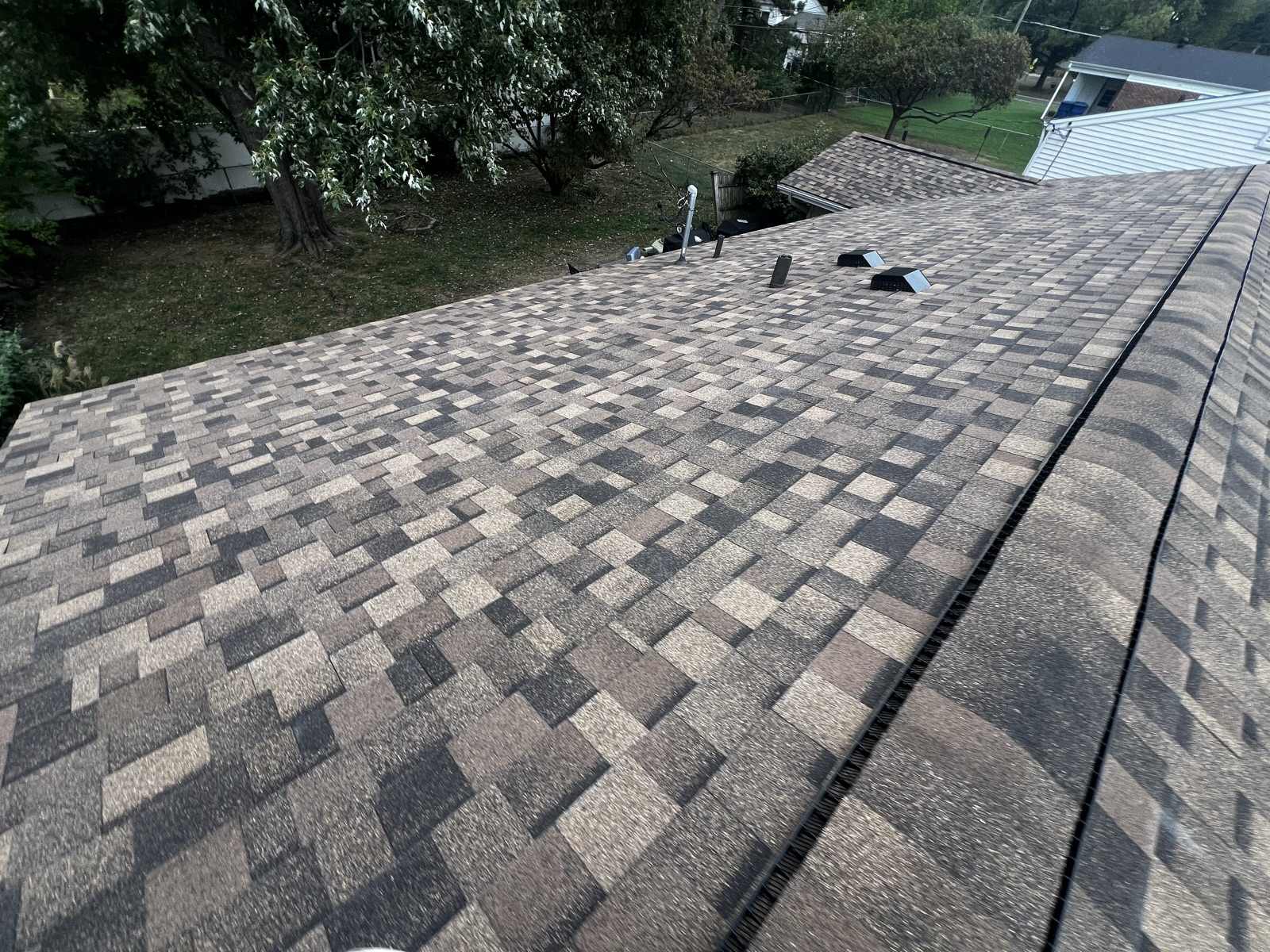
Reading a guard from the ground
Most of what you need to know can be seen without a ladder, provided you look during rain rather than after it.
What you will be told
Once these are on you can forget about the gutters completely.What happens on the roof
What people actually do is forget, and the guard works well enough for long enough that forgetting seems justified. Then somewhere in year three or four the throughput has dropped far enough to matter and nobody has looked.
The realistic habit is two looks a year and neither of them takes long. One in the first week of May, during rain, from the ground. One in late November after the leaf is down.
That is the honest maintenance schedule for a guarded gutter in this climate, and it is a fraction of what an unguarded one needs. Which is exactly the improvement worth paying for, described accurately.
What to do about a blinded mesh
Fine grit in a stainless weave does not come out with a leaf blower and it does not come out with a garden hose from below, because both push it further in. It comes out with water from above and a soft brush, worked along the run, which means somebody has to be up there with the right kit. Anyone quoting for a mesh guard should be able to tell you who does that, how often, and what it costs, and if they cannot, that is the answer to the question.
If something has changed and you are not sure which of these it is, the fastest route is a description over the phone. What it does, in what kind of rain, and roughly when it started.
After fitting
Guards on already and something has changed
Overflowing that did not happen last year, a section standing off the lip, water running behind the gutter, or a stain appearing on a fascia board. Any of those is worth a look before the wet half of the year.
Keys Roofing works on gutters, downspouts and roofs, so whatever is behind it gets looked at as one thing.
Straight to the Keys office. Roofing, gutters and downspouts across greater St. Louis. No siding, no windows, no commercial work.